
Some new, articulate voices have appeared on the Swedish landscape, in the battle against a brand of “invisible” racism and discrimination reserved for Asians. Could this mean that awareness of the issue is on the rise? Perhaps I’m not alone after all?
YOU’RE WEARING DOWN MY VERY SOUL
Translated from Helsingborg’s Dagblad article (Swedish)
by Patrik Lundberg,
September 13, 2011
 I am used to being humiliated. About once a week, someone calls out from behind me, “Hey, check it out, it’s a Chinaman!” Or someone approaches with greetings in a language that is foreign to me.
Nowhere am I safe. I am stalked by denigrations on radio and television. Joking about and laughing at Asians seems to be the only form of racism that can pass unnoticed. Stretching your eyes with your fingers or saying L instead of R will suffice to get audiences choking with laughter.
However, nobody is complaining. As long as nobody is kicking up a fuss about it in the media, does that really mean there is no reason to react? 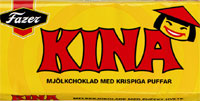 Just consider Fazer’s China puffs, with it’s packaging adorned by a bright-yellow cone-hatted Asian with eyes as skewed as a Saturday play — yet it’s not one bit better than Nogger Black ice-cream, which caused such an outcry that it had to be withdrawn.
Sometimes I blame myself: Why don’t I speak up against it? Why don’t I make a police report? Why am I not breaking their noses with my yellow knuckles? I swear, I have tried, but my reactions are dismissed as demands for political correctness.
We should of course be free to joke about anything, but please be informed: you are tearing my soul apart.
I’ve stopped socializing in public with my Asian friends. I have stopped walking with a camera around my neck. I cannot stand being laughed at anymore. My tormentors have defeated me. I cannot win this battle, when no one else but me considers such behavior to be a problem.
Strangely enough, it is seldom your average stereotypical racist — an islamophobe who listens to Viking rock and votes for the brownshirts — who is responsible for such abuses. No, it’s your average ordinary Joe who seizes on the opportunity to make fun of someone who won’t put up a fight.
Remember the children’s book, Spotty? It’s about a spotted rabbit growing up in a family where everyone else is pure white. In one chapter, Spotty tries to bleach his spots with stain remover.
I’ve bleached my hair and contemplated having eye surgery. A few years ago, I even moved to Korea to see if I could better fit in. I could, but I moved back six months later.
That’s because I prefer to live in Scandinavia. But about once every week, I just feel like dying.
From out of nowhere, Henrik Arnstad emerged, mincing no words with his Dagens Nyheter article titled, Society’s last permissible form of racism, in which he quoted, among others, researcher Tobias Hübinette’s 2009 report on media-generated perceptions of Asians in Sweden: “Japanese, Japanese, Japanese …”: Representations of East Asians in contemporary Swedish visual culture.
It was a breath of fresh air to see that a recent critique of Chinese artist Ai Weiwei published in the daily paper, Expressen, embedded with racial put-downs, which would normally never have raised a single Swedish eyebrow, was given a proper rebuttal by artist and author Leif Holmstrand, who saw right through the supremacist attitude of the art critic. The critic had claimed that Ai’s art would never have amounted to much of anything, if it hadn’t been for the fact that he was a dissident — the privilege of his being granted a Scandinavian exhibition was, supposedly, essentially due to pity. In spirit, this wasn’t too different from the media backlash against basketball superstar Jeremy Lin, who was dismissed as being the mere product of racial favoritism.
I knew I wasn’t alone, when I came across some articles by Swedish journalist Patrik Lundberg, who articulated almost word for word, the very issues I’d been venting for years, but in Swedish — Patrik is what they call “Swedish, but from Korea.”
Although Swedes typically demand an explanation from Asians about how they ended up in their fine country, and although Swedes typically reject answers that anyone of Asian descent could possibly “come from” England or France or the US, they will often make provision for an Asian claiming to be “from Sweden,” as long as they admit to being a Korean adoptee and to being from “Korea originally.” Outside of this narrowly defined framework, any Asian who claims otherwise is simply a usurper — it doesn’t matter if they were born there.
The term, Perpetual Foreigner Syndrome, was coined by Dr. Frank Yu to describe the assumptions made about, and the marginalization of, Asians in the West — the instinctive perception of Asians as inassimilable noncitizens and sojourners.
Swedes, who are widely regarded as champions of humanist issues, can be disappointingly obtuse. Their excuse of having only recently been exposed to immigrants just doesn’t hold water. One in 20 Swedes are of Finnish descent. For decades, there have been influxes of immigrants from the former Yugoslavia; for centuries, coveted metalsmith Walloons from Belgium have been moving to Sweden in successive waves; the “father of Swedish industry,” Louis De Geer, was Dutch; Swedish king Karl XIV was a French import and the Swedish language is now French-influenced as a result; celebrated “Swedish” folk singer and troubadour Cornelius Vreeswijk was Dutch; the queen has German roots. The list is endless.
Still, as much as I am exposed to classic Swedish blind-spots to their own racism and ignorance, it never fails to surprise me that an African American’s claim of being “from the US” can be such a hard pill for Swedes to swallow. Refusing to let it rest at that, Swedes will typically ask repeatedly where the African American is from “originally” because the answer they want is “Africa.” In other words, consciously or unconsciously, Swedes subscribe to the Manifest Destiny of whites in America. They can be pretty hung up on matters of race, to say the least.
Hang-ups about race may be more Swedish than you think. In October 2009, the Journalist and Green Party politician, Gustav Fridolin, released a three-part television documentary titled, Our secret history (alternatively, Our dark history) highlighting Sweden’s longstanding advancement of racist concepts:
- The origin of this hang-up over origins and the very Swedish obsession of measuring and comparing differences, is the Swede Linnaeus’ taxonomic labeling of species in the 1700s, which went on to form the now-disproven “scientific” basis for ideas about racial hierarchy (with Europeans at the top), which was utilized to justify colonialism and ethnic cleansing.
- Sweden was a significant contributor to the slave trade and in its endeavors to become a major player, had secretly maneuvered to take control of the colony of St. Barthélemy — a major slave trading center. As other countries were receding from the practice, the King of Sweden saw an opening and lied to abolitionists that he was on their side, while seizing market share.
- Sweden was home to the world’s first State Institute for Race Biology, where ideas about eugenics and racial sanitation (a.k.a. ethnic cleansing and genocide) were developed. These were adopted by Nazi Germany and used in Sweden, among other things, for the forced sterilization of Gypsies and the mentally deficient, as well as the suppression of the indigenous Sami population. Ironically, although such programs to eradicate undesirables remained intact until as late as 1975, the press and mainstream stopped talking openly about racial supremacy sometime after WWII, on the defeat of Aryanist Germany. Sweden began pretending that none of this existed — it was tantamount to an overnight pseudo-transformation through denial. It is also interesting to note that holocaust denial is explicitly or implicitly illegal in 17 European countries, but not in Sweden.
Racism denial seems to be firmly rooted in the Swedish psyche.
Kristina Lindquist hit the nail on the head in her article, Calling racism by its correct term, when she said that Swedes want to be able to freely use racist terminology without being labeled a racist. They want to be able to call those of African descent “niggers” and to perpetuate colonialist-era concepts, decide where people belong (or come from) in the grand scheme of things, but not be accused of Old World thinking. They want to be able to act racist, talk racist, be racist, but not be called racist.

A slave auction theme party at Halland Nation attended by approximately 90 university students, was called a “racist spectacle” by US civil rights activist Rev. Jesse Jackson, who wrote to the Swedish Minister for Education Jan Björklund, urging Sweden to question the perpetrators and take measures to ensure that Swedes are made aware of the brutal reality of the transatlantic slave trade and the significant part Sweden played in it.
In the face of a slave auction that roused the ire of Rev. Jesse Jackson and when confronted with Patrik Lundberg’s article, You’re tearing my soul apart, Swedes have tended to fire back with massive salvos of rebuttals. Hundreds of hyperbolic blogs have sprung up to twist, belittle and ridicule Patrik’s assertion that laughing at Asians seems to be the only form of racism that passes unnoticed these days.
Racism against Asians seems to be flying under the radar. Perhaps people are accustomed to getting away with it. While they would think twice about pulling out their lower lip to mock someone with African features, they don’t seem to hesitate at stretching their faces to make squinty eyes at an Asian or mock their pronunciation abilities. If an Asian has the audacity to be offended, the typical reaction is that they choose to be offended about “nothing.” The fault is theirs, for having a lousy sense of humor. The unwritten social contract calls for Asians to accept open denigration. Most of the responses I’ve had to my objections are along the lines of, “What the f**k is your problem?”
On occasion, I am met with protests of “No, no! You should take it as a compliment. I consider Asians to be hardworking and clever people!” But to see any one nationality/ethnicity/culture as superior or inferior to another is a flawed concept. Positive or negative race-based appraisals are two edges of the same sword. The very same thinking that Asians belong to an industrious “model minority” is also the basis for the reasoning that Asians are submissive, peaceable and agreeable — and therefore, it’s perfectly alright to openly denigrate them.
The ignorance I encounter comes from your average Joe Svensson — conservatives and liberals alike, the educated and “culturally enlightened,” including the “cool cats,” such as musicians. But whenever I bring up my feelings about the matter, the usual response has been, “well, everyone gets discriminated against in one form or another, through sexism, ageism, for being Jewish or a redhead, etc.” But anti-Asian racism and discrimination simply cannot and should not be absorbed into the “white” experience, Jewish experience or any other experience. It is most certainly a brand of discrimination and racism reserved for Asians in particular, and consequently, it deserves its own special category.
Even if an argument could be made that conscientious racism is less common in Sweden, ignorance and unconscious racism abound. As I see it, the biggest problem is that as long as Swedes deny or remain unaware of their own racist thoughts and behaviors, as long as they insist that their racist undertones are not race-based, or that there are no grounds whatsoever for accusing them of being racist to any degree, their ignorance will never be properly addressed. Unconfronted ignorance is fertile ground for conscientious racism.
So here’s a big thumbs up for Gustav Fridolin (whether or not I agree with his politics), Henrik Arnstad, Patrik Lundberg, Kristina Lindquist and Leif Holmstrand.
Wait...! Is that a light I see at the end of the tunnel?
©Zak Keith 2012


